
Derivatives of bead cellulose:
Reactive Sorbents:
Selected applications:
More informations:
Magnetic Macroporous Bead Cellulose MG
Pure or its derivatives for magnetic separations | General informations
Macroporous Bead Cellulose MG and its derivatives can be used for izolation or magnetic modification of biologically active matters, cells, sub-cellular components, contaminants of environment or other matters of studied systems. Especially advantageous is their use in microbiology, cell biology, medicine, biochemistry, biotechnology and ecology.
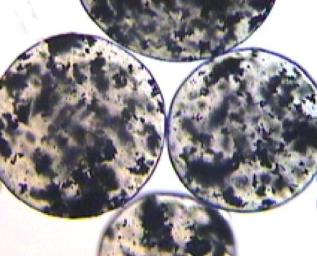
Only magnetic derivatives with ion-exchange functional groups are delivered (Iontosorb MG SHP, MG CM, MG TMAHP a MG DEAE). For example: Are you interested in → IONTOSORB SHP? We can produce you MAGNETIC SORBENT IONTOSORB SHP. But SHP 100 or SHP 200, because Magnetic Macroporous Bead Cellulose and its derivatives are made in these porozities only:
 |
| Porozity | Particle size [microns] |
|---|---|
(50), 100, 200 | 30 - 50 |
| 50 - 80 | |
| 80 - 100 |
Basic properties of derivatives IONTOSORB are the same both for magnetic or non-magnetic beads.
Magnetic macroporous bead celulose (types MG) is produced by the same technology as a classic macroporous bead cellulose (types MT) with the only difference that MG has in its matrix built in Fe3O4 in amount min. 30 % related to dry matter.
These Fe3O4 particles are present in the cellulose matrix and therefore macroporosity is not influenced by the Fe3O4 particles. This fact corresponds also with a B.V. for Iontosorb MG re-calculated to MT.
If an average experimental B.V.value for MG = 7.4 mlg-1 of dry matter MG and a determined ash content 29.7 %, then the bellow given equation can be used for the re-calculation of the found B.V. of MG to a calculated B.V., which would correspond to the MT without Fe3O4.
Calculation of B.V. value from MG to MT:
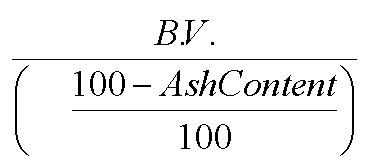 |
Ash Content [%] for MG,
B.V. found for MG [ml-1 grame dry per MG]
| Porosity of MG | B.V. for Iontosorb MG [ml g-1 dry] | |
|---|---|---|
| minimum | maximum | |
| 50 | 5.0 | |
| 100 | 7.50 | 9.10 |
| 200 | 9.30 | 10.60 |
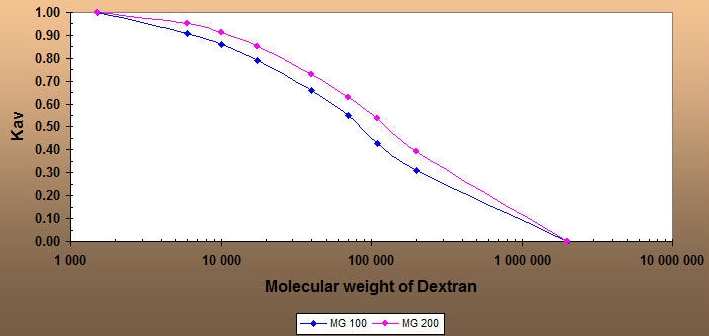
Macroporous Bead Cellulose MG types are highly porous gels well accessible for large macromolecules, as it is shown in this Figures.
| Selectivity curves of Macroporous Bead Cellulose MG types Kav vs. Molecular Weight of Dextran in semilogarithmic scale |
 |
| Bead Cellulose Sorbents | IONTOSORB | Functional Groups | Praticle Size [μm] | |
|---|---|---|---|---|
| Cation Exchangers | Strongly acidic | MG SHP | Sulphonic | 30 - 50 50 - 80 80 - 100 100 - 250 |
| Weakly acidic | MG CM | Carboxymethyl | 30 - 50 50 - 80 80 - 100 100 - 250 | |
| Anion Exchangers | Strongly basic | MG TMAHP | Trimethyl | 30 - 50 50 - 80 80 - 100 100 - 250 |
| Weakly basic | MG DEAE | Diethylaminoethyl | 30 - 50 50 - 80 80 - 100 100 - 250 | |
| We kindly ask you to tell us in your orders a required content of functional groups in the Iontosorb MG derivative, for example Iontosorb MG CM 200 L. | |
| Low | 0,08 - 0,18 |
| Medium | 0,20 - 0,48 |
| Hegiht | 0,50 - 0,90 |
| Very height | 1,0 - 1,26 |
Applications
Click to read whole article on .pdf
- → Magnetic Cation Exchange Isolation of Lysozyme from Native Hen Egg White
- → Immobilization of Laccase on Magnetic Carriers and Its Use in Decolorization of Dyes
- → MagneT Protein A Beads and MagneT Protein G Beads for Antibody Purification
- → Microwave-Accelerated SPOT-Synthesis on Cellulose Supports
- → Strategies To Recover and Purify Lysozyme from Egg White
- → Characterization of Magnetically Responsive Microcapsules
- ↑ UP THIS PAGE.